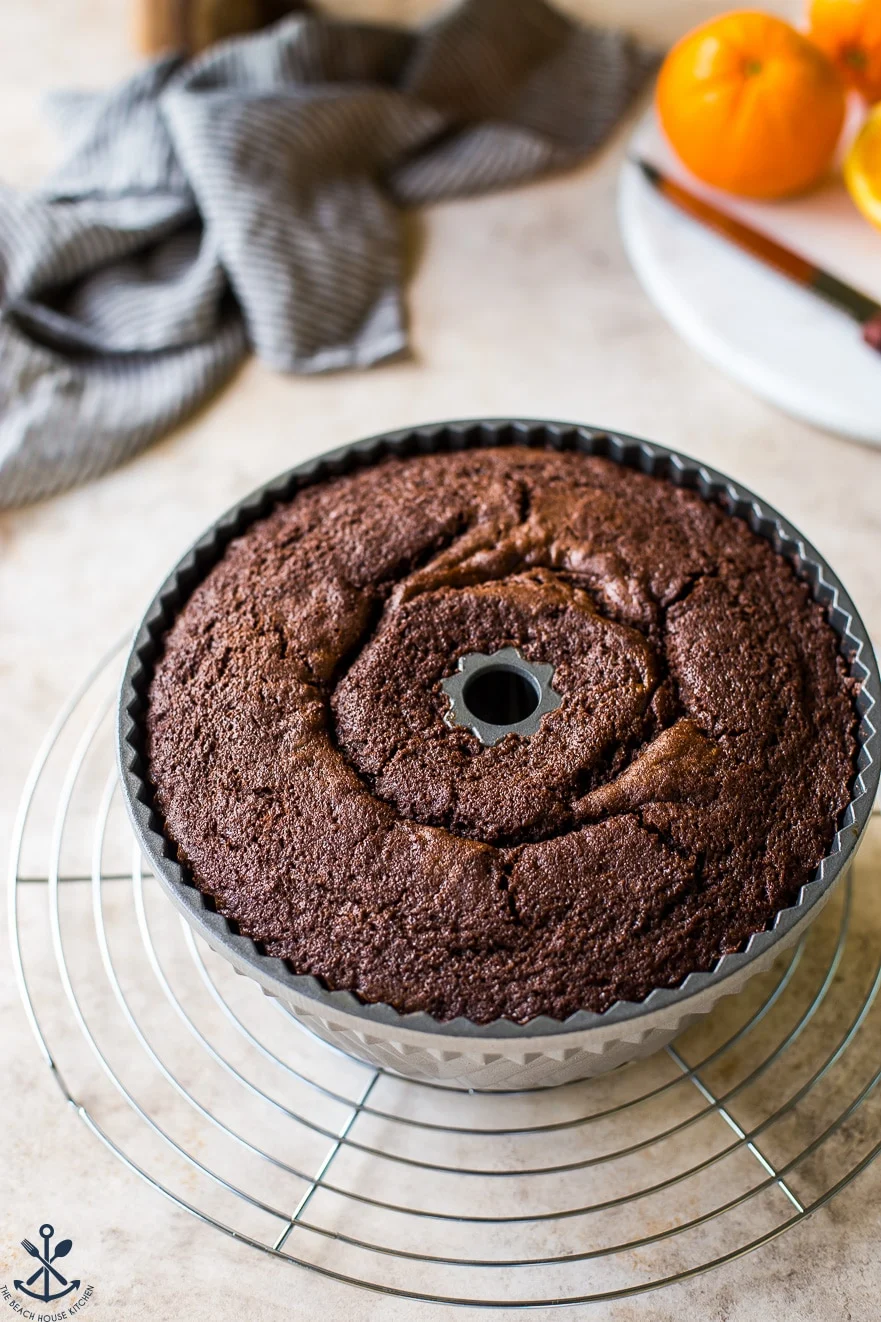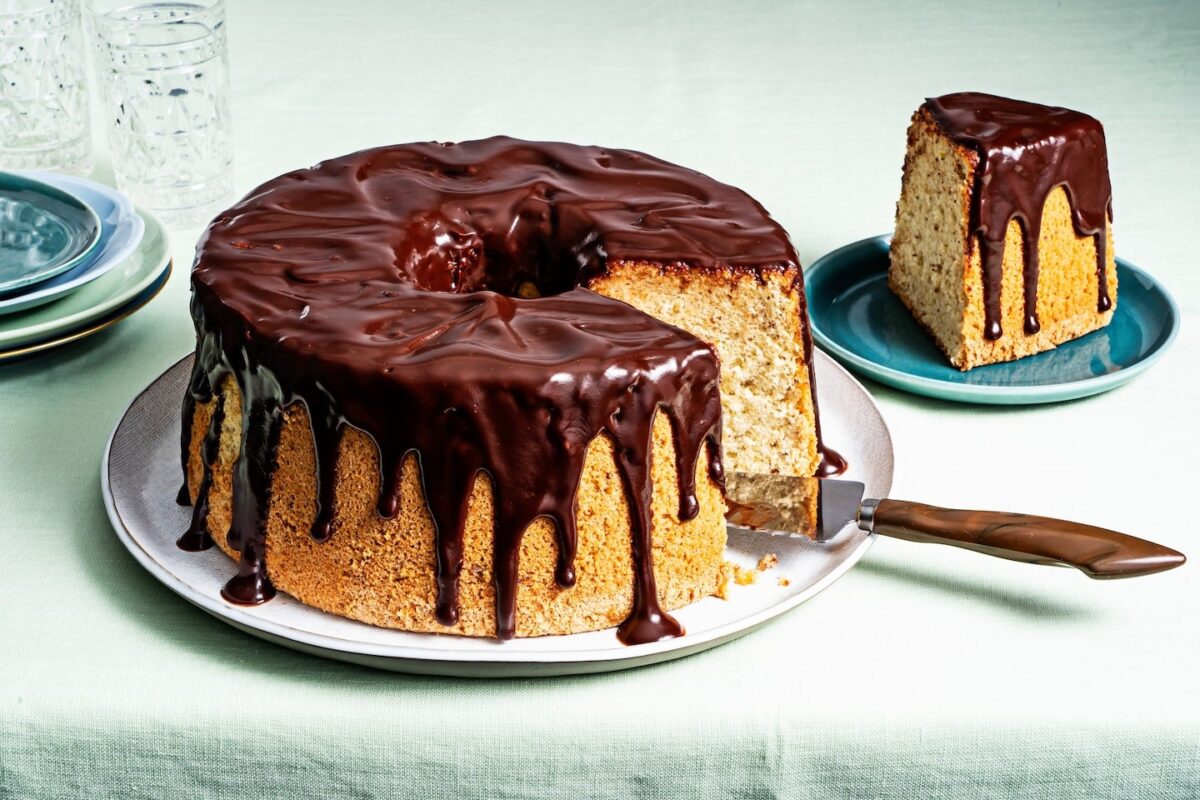
Chocolate Orange bundt cake

By MaryAnn Dwyer. Source: The Beach House Kitchen. Servings: 10.

Ingredients

  • 2 1⁄2 cups all-purpose flour
  • 3⁄4 cup unsweetened cocoa powder
  • 1 tsp baking soda
  • 1 tsp kosher salt
  • 1⁄2 tsp ground cinnamon
  • 1 cup unsalted butter, room temperature
  • 2 cups granulated sugar
  • 4 large eggs
  • 1 tsp vanilla extract
  • 1 1⁄4 cups freshly squeezed orange juice
  • 2 Tbsp freshly grated orange zest

Instructions

  1. Preheat oven to 325 degrees. Generously spray a 10-cup bundt pan with nonstick baking spray with flour. Set aside.
  2. In a large bowl, whisk together flour, cocoa powder, baking soda, kosher salt and cinnamon until well combined. Set aside.
  3. In the bowl of a stand mixer fitted with a paddle attachment, beat butter and sugar until light and fluffy, about 3 minutes, scraping down the bowl as needed.
  4. Add eggs, one at a time, making sure to beat well after each addition. Add the vanilla. Add the flour mixture in 3 separate additions, alternating with the orange juice, starting and ending with the flour mixture. Fold in the orange zest.
  5. Pour the batter into the prepared pan, tapping the bundt pan on the counter to release any air bubbles. Bake until a toothpick inserted near center of cake comes out mostly clean (just a few crumbs), about 50-55 minutes.
  6. Cool in pan for 10 minutes. Remove from pan and let totally cool on a wire rack.

Notes

  • Glaze: dust with confectioners’ sugar, or do an orange-flavored glaze. I would use 1 cup of sifted confectioners’ sugar mixed with 1-2 tablespoons of orange juice.
  • Option: add a tsp of espresso powder to enhance the flavor of the chocolate.

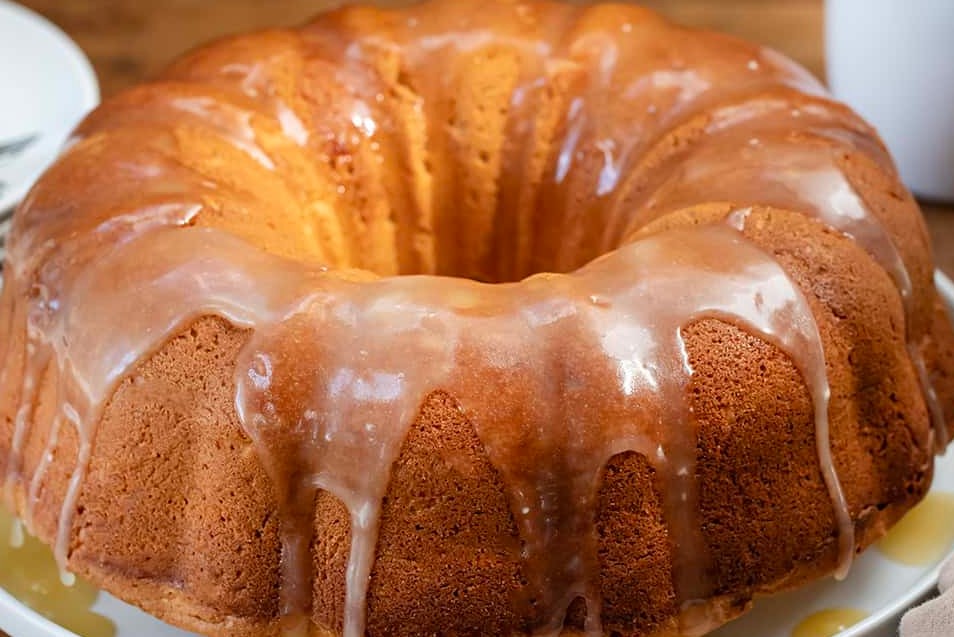
Brown Sugar Maple Pound Cake

Source: iambaker.net.

Ingredients

For the pound cake

  • 1 package (8 ounces) cream cheese, room temperature
  • 1 1⁄4 cups (2 1⁄2 sticks / 283.5g) unsalted butter, room temperature
  • 2 cups (400g) light brown sugar, packed
  • 1 cup (200g) granulated sugar
  • 6 large eggs, room temperature
  • 2 teaspoons maple extract
  • 3 cups (390g) cake flour
  • 1⁄4 cup (61g) buttermilk, room temperature

For the maple glaze

  • 1⁄4 cup (1⁄2 stick / 57g) unsalted butter
  • 3 tablespoons pure maple syrup
  • 3 tablespoons heavy whipping cream
  • 1⁄2 cup (62.5g) confectioners’ sugar

For the quick glaze

  • about 1⁄4 cup whipping cream
  • 2 cups powdered sugar
  • 1 tsp maple extract

Instructions

  • Preheat oven to 325°F. Spray a 10-inch bundt pan with non-stick cooking spray. Set aside.
  • In the bowl of a stand mixer fitted with the paddle attachment, beat the cream cheese and butter on medium speed until smooth, about 3 minutes.
  • Gradually add the brown sugar and granulated sugar, mixing until light and fluffy, about 2-3 minutes.
  • Add the eggs, one at a time, mixing well after each addition.
  • Add the maple extract and mix until well combined.
  • With the mixer on low speed, gradually add the cake flour, mixing just until the flour is fully incorporated.
  • Mix in buttermilk until just combined. Scrape down the sides of the bowl to ensure everything is mixed well.
  • Pour the batter into the prepared bundt pan and smooth the top with the spatula. Bake for 75-80 minutes, starting to check for doneness at 1 hour by inserting a toothpick into the center of the cake. If it comes out with just a few crumbs but no wet batter, it’s done. The cake should have a deep golden brown crust on the edges and a lighter center.
  • Once baked, let the cake cool completely in the pan before inverting onto a serving plate.

For the maple glaze

  • While the cake cools, prepare the maple glaze. In a small saucepan over medium heat, combine the unsalted butter, maple syrup, and heavy whipping cream. Bring the mixture to a boil and continue boiling for 1 minute.
  • Remove the pan from heat and immediately whisk in the confectioners’ sugar until smooth. Let the glaze cool for 25-30 minutes, or until it has slightly thickened.
  • Once the cake has cooled and the glaze has thickened, drizzle the glaze evenly over the cake.
  • Let the glaze set slightly before serving.

For the quick glaze (in a hurry)

  • Whisk together whipping cream, powdered sugar, and maple extract. Add more sugar or cream to get desired consistency.

Notes

  • No salt or baking soda or powder needed for the cake.
  • For the buttermilk I now use King Arthur’s buttermilk powder with water; this needed 1 tablespoon per 1⁄4 cup water.

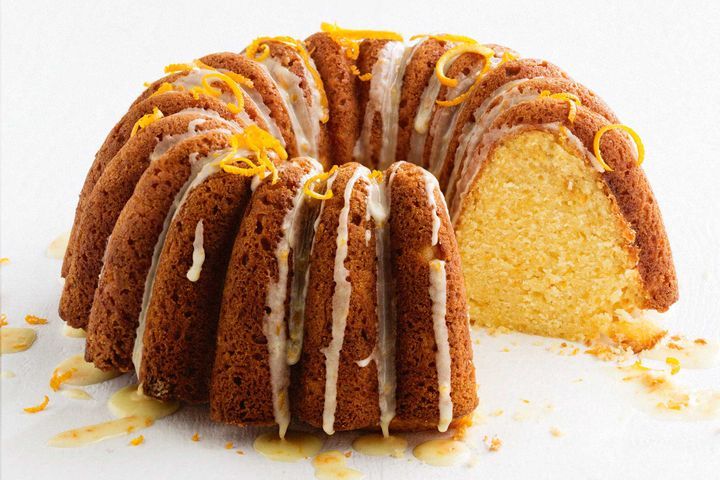
Orange and creme fraiche cake

By Alison Adams. Source: taste.com.au.

Ingredients

  • 250g (1 cup) creme fraiche
  • 3 eggs, lightly whisked
  • 2 oranges, rind finely grated, juiced (or 1 really large orange)
  • 375g (2 1⁄2 cups) plain flour
  • 2 tsp baking powder
  • 1⁄2 tsp bicarbonate of soda
  • 200g (1.8 sticks) unsalted butter, chopped, at room temperature
  • 215g (1 cup) caster sugar
  • 150g (1 cup) icing sugar (also called powdered sugar)
  • 2 tsp milk
  • orange zest, to serve

Instructions

  1. Preheat oven to 350°F (180°C / 160°C fan-forced).
  2. Grease a 2.25L bundt pan.
  3. Combine the creme fraiche, egg and 80ml (1⁄3 cup) of the orange juice in a bowl.
  4. Whisk together the flour, baking powder and bicarb in a separate bowl.
  5. Use electric beaters to beat the butter, caster sugar and 1 tbs of the orange rind in a large bowl on medium speed for 12 minutes or until very pale and creamy.
  6. Gradually fold in the flour mixture and creme fraiche mixture, in alternating batches, until the mixture is smooth and combined.
  7. Transfer the mixture to the prepared pan. Bake for 35-40 minutes or until a skewer inserted in the cake comes out clean.
  8. Cool in the pan for 10 minutes before turning out onto a wire rack to cool completely.
  9. Sift the icing sugar into a bowl. Add the milk, 3 tsp of orange juice and the remaining orange rind.
  10. Stir until combined.
  11. Drizzle over the cooled cake.
  12. Sprinkle with orange zest.

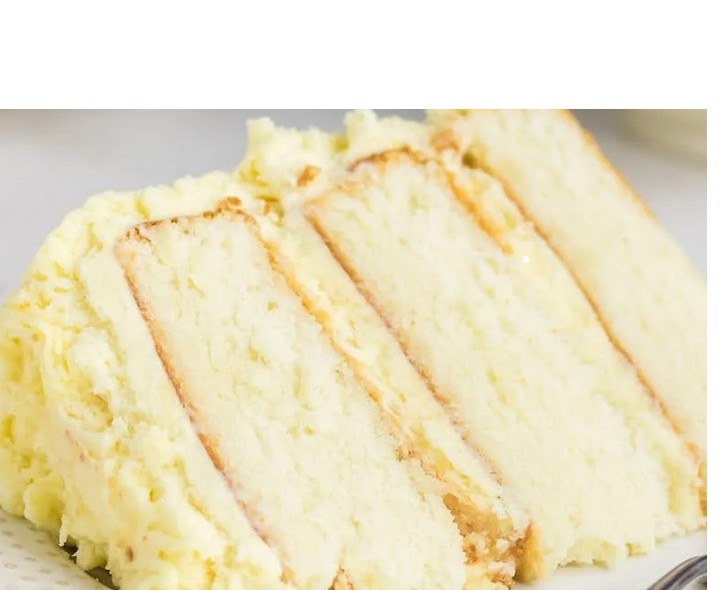
White Velvet Cake

It’s an easy, from-scratch layer cake that’s fluffy and moist with a velvety, tender vanilla crumb. Also called Vintage Buttermilk Cake. Source: Marye Audet-White, restlesschipotle.com.

Ingredients

  • 4 cups cake flour
  • 1 teaspoon baking soda
  • 1⁄2 teaspoon baking powder
  • 1⁄2 teaspoon salt
  • 1 cup unsalted butter, room temperature
  • 3 cups sugar
  • 2 tablespoons vanilla (I used clear vanilla)
  • 2 cups buttermilk, room temperature
  • 6 egg whites, unbeaten, room temperature

Equipment

  • 3 8-inch round cake pans
  • stand mixer
  • rubber spatula

Instructions

  1. Preheat the oven to 350 degrees.
  2. Grease 3 8-inch round cake pans and line the bottoms with a circle of wax paper or parchment. Set aside. (My pans are Wilton with high sides. If you have pans with lower sides you may get 4 layers instead of 3.)
  3. Sift together the flour, salt, baking powder and baking soda in a large bowl. Set flour mixture aside.
  4. Cream butter and sugar until light and fluffy.
  5. Beat in vanilla.
  6. Add dry ingredients in three additions, alternating with the buttermilk, beating well after each addition.
  7. Add egg whites and beat at medium speed for two minutes.
  8. Divide equally between prepared pans.
  9. Bake at 350 degrees for 20 minutes, reduce heat to 325 and bake for 25 minutes more, or until the cake tests done (a wooden pick inserted in the center comes out clean).
  10. Cool in pans 10 minutes, then turn out and finish cooling on a wire rack.
  11. Fill and frost as desired.

Notes

  • Storage: wrap the unfrosted cake layers in plastic wrap and store for 2 days at room temperature, or freeze for up to three months. Once frosted, room temperature for up to 5 days depending on the frosting.
  • Tip: make sure everything is at room temperature for best results.
  • Large eggs were used for the egg whites in this recipe.
  • Start creaming butter and sugar with the paddle attachment, then switch to the whisk attachment to finish it off. It takes about 7 minutes to cream the butter properly.
  • Using parchment or wax paper rounds on the bottom of the cake pan allows you to remove the cake easily.
  • Use any frosting you like. Cream cheese frosting is good here.
  • If you accidentally over-bake the cake and it seems dry, brush with sugar syrup. Bring 1⁄2 cup sugar and 1⁄2 cup water to a boil, stirring constantly until sugar dissolves — about 2 minutes. Cool completely and brush on 2 tablespoons per layer.

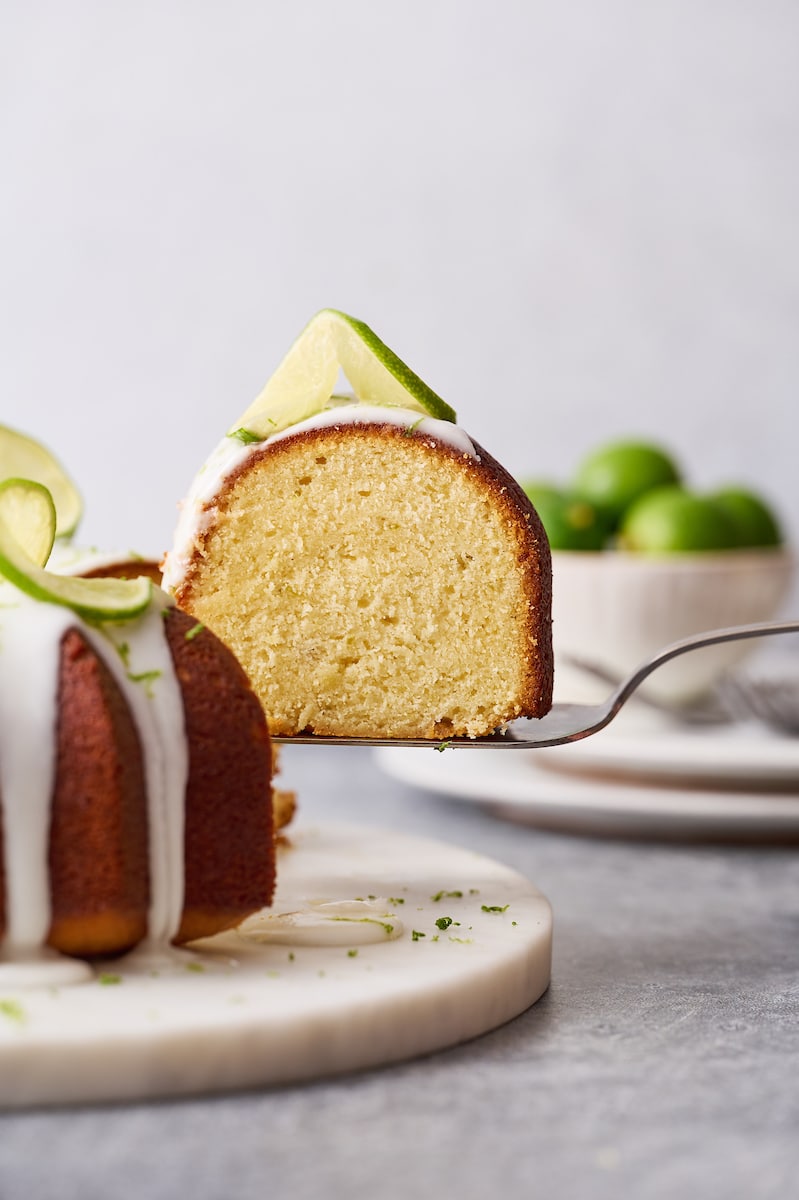
Key Lime Bundt Cake

This cake makes it into the top 5 favorites! Source: bakerbynature.com.

Ingredients

For the cake

  • 3 cups (360g) all-purpose flour
  • 2 teaspoons baking powder
  • 1⁄2 teaspoon salt
  • 1 1⁄2 cups (340g) unsalted butter, room temperature
  • 1 cup (227g) brick-style full-fat cream cheese, room temperature
  • 2 cups (398g) granulated sugar
  • 2 teaspoons pure vanilla extract
  • 5 large eggs, room temperature
  • 1⁄2 cup (113ml) key lime juice
  • 3 tablespoons (36g) key lime zest, finely grated
  • 2 tablespoons (28ml) canola oil

For the soaking syrup

  • 1⁄3 cup (76ml) key lime juice
  • 1⁄2 cup (99g) granulated sugar

For the icing

  • 2 cups (228g) confectioners’ sugar, sifted
  • 1⁄4 teaspoon salt
  • 2 1⁄2 tablespoons (35ml) key lime juice
  • lime zest, finely grated, for garnish (optional)
  • lime spirals for garnish (optional)

Instructions

For the cake

  • Preheat the oven to 325°F. In a medium mixing bowl, whisk the flour, baking powder, and salt together until well combined. Set aside.
  • In the bowl of a stand mixer fitted with the paddle attachment, or in a large bowl using a handheld electric mixer, beat the butter and cream cheese on medium speed until smooth and creamy, about 1 minute.
  • Gradually add in the sugar, then increase the speed to medium-high and continue beating until light and fluffy, about 3 minutes. Beat in the vanilla extract.
  • Reduce the speed to medium, then add in the eggs, one at a time, beating well after each addition and scraping down the sides of the bowl as needed. Beat in the lime juice, lime zest, and oil.
  • Reduce the speed to low and add in the flour mixture, mixing just until combined.
  • Generously grease a 10-inch (12-cup) bundt pan, being sure to coat all of the nooks and crannies. I suggest using a non-stick baking spray that has flour in it, or greasing the pan with shortening or butter, then dusting it with flour.
  • Scrape the cake batter into the pan and, using a rubber spatula, evenly smooth the top.
  • Bake for 60 to 65 minutes, or until the cake is golden brown AND a toothpick inserted into the center of the cake comes out clean. Allow the cake to cool in the pan, set on a wire rack, for 10 minutes. Then invert the cake onto the rack.
  • Slowly brush the warm lime soaking syrup all over the cake, top and sides, allowing it to sink in before adding more.
  • Once all of the syrup has been added, set the cake aside to cool completely, about 2 1⁄2 hours.

For the soaking syrup

  • In a medium saucepan, combine the lime juice and sugar. Bring to a simmer over medium heat and cook, whisking frequently, just until the sugar has completely dissolved. Remove from heat and use as directed above.

For the icing

  • In a large liquid measuring cup or bowl, combine the sugar and salt. Whisk in the lime juice, mixing until just combined. The mixture should be super thick and just barely pourable. If the glaze is too thick, add more lime juice, a teaspoon at a time. If the glaze is too thin, add more confectioners’ sugar, a tablespoon at a time.
  • Drizzle the glaze over the cooled cake. Decorate with lime zest and lime spirals, if using. Then allow it to set for 20 minutes. Slice and serve!

Notes

  • If you cannot find key limes, you can use bottled key lime juice and just regular lime zest.
  • This cake was developed specifically to be baked in a bundt pan; results may vary in a 9×13-inch pan or as cupcakes.
  • Make sure your butter and cream cheese are at room temperature or they won’t properly cream.
  • Do not cut back on the sugar or your cake will be overly tart. Don’t substitute brown sugar — the molasses undertone doesn’t pair well with key lime.

Hazelnut Chiffon Cake

A chiffon cake is a splendidly tall, wildly easy, oil-based cake. It is rich in flavor from egg yolks, yet wonderfully light in texture due to copious amounts of stiffly peaked whites. The cake is whisked together in a single bowl (you’re welcome) except for the whipped whites, which get added at the end.

By Jessie Sheehan. Source: Washington Post. Servings: 12-16 (1 large cake baked in a 10- to 12-cup tube pan).

Ingredients

For the cake

  • 7 large eggs, cold or at room temperature, whites and yolks separated
  • 1 2⁄3 cups (335 grams) granulated sugar, divided
  • 3⁄4 cup (180 milliliters) cold tap water
  • 1⁄2 cup (120 milliliters) vegetable or hazelnut oil
  • 1 tablespoon baking powder
  • 2 teaspoons vanilla extract
  • 1⁄2 teaspoon kosher salt
  • 2 cups (225 grams) cake flour
  • 1 cup (130 grams) whole hazelnuts, finely ground in a food processor, or 1 1⁄2 cups (130 grams) hazelnut flour or hazelnut meal
  • 1⁄4 teaspoon cream of tartar
  • Chopped hazelnuts, for decorating

For the ganache

  • 1 cup (285 grams) Nutella or another chocolate-hazelnut spread
  • 1⁄2 cup (120 milliliters) heavy cream
  • 1 tablespoon vegetable or hazelnut oil

Instructions

  1. Active: 30 mins | Total: 3 hours 15 mins
  2. Position a rack in the middle of the oven and preheat to 325 degrees. Have ready an ungreased 10- to 12-cup tube pan with a removable bottom.
  3. In a large bowl, whisk the egg yolks, 1 cup (200 grams) of the sugar and the water for about 30 seconds, until the mixture lightens slightly in color. Whisk in the oil, baking powder, vanilla and salt.
  4. Sift the cake flour into the bowl, add the ground hazelnuts and whisk until just combined.
  5. In the bowl of a stand mixer fitted with the whisk attachment, whip the egg whites and cream of tartar on medium-low until the egg whites become frothy, about 2 minutes. Next, whip the mixture on medium-high until, when you lift the whisk out, a soft peak forms and flops over at the tip, about 3 minutes.
  6. With the mixer on medium, slowly add the remaining 2⁄3 cup (135 grams) of granulated sugar to the egg whites. Increase the speed to medium-high and continue whisking until stiff peaks form, about 3 minutes. If they flop over, they need more time; if they hold a point, you’re set.
  7. Gently fold a third of the whipped whites into the batter until they disappear. Be sure to fold with the lightest touch, so as not to deflate the whipped egg whites. Add another third and fold them in, followed by the final one, folding until just combined.
  8. Transfer the batter to the pan, smooth the top with a small offset spatula and bake for 1 hour to 1 hour and 10 minutes, or until the top springs back when pressed with a fingertip and a cake tester inserted in the middle comes out with a moist crumb.
  9. Remove from the oven and, if possible, invert the cake onto a thin-necked bottle, such as a wine bottle. Cooling the cake upside down keeps it from slightly deflating. Let cool for about 1 1⁄2 hours, or until it comes to room temperature.
  10. To remove the cake from the pan, gently run a long knife around the outside edge of the cake and around the inside tube. Remove the sides of the pan, run the knife between the bottom of the cake and the pan and carefully lift the cake off the pan. Place it on a cooling rack set over a baking sheet.
  11. To make the ganache, place the Nutella in a small bowl. In a small saucepan over medium heat, warm the cream until tiny bubbles appear around the edges, about 3 to 5 minutes. Pour the cream over Nutella and let it sit for about 1 minute. Using a fork, begin stirring from the center of the bowl until the cream and Nutella are thoroughly combined. Add the oil and continue to stir until emulsified.
  12. Generously drizzle the cooled cake with the ganache, letting it decoratively drip down the sides. You will have some ganache left over. Let the glazed cake set briefly, about 15 minutes, before serving. Slice and serve with more ganache.

Notes

  • Chiffon cakes are traditionally baked in an ungreased tube pan with a removable bottom, in a low oven, for a long time. When the cake emerges from the oven, invert it to cool rather than cooling right-side up on a rack. Many tube pans have tabs or feet for inverting; if yours does not, suspend the pan on the neck of a wine bottle. This helps the cake retain its height. (If you don’t have a suitable pan or bottle, the cake should deflate only slightly.)
  • There is no need to peel the hazelnuts, as the skins add color and texture. If you do not have a food processor, consider buying hazelnut flour.

Best Lemon Buttermilk Cake Recipe

The absolute best southern lemon layer cake you will ever try. Adapted from Sommer Collier (A Spicy Perspective).

Ingredients

For the cake

  • 2 3⁄4 cups cake flour, sifted (or 2 1⁄2 cups all-purpose flour + 1⁄4 cup cornstarch)
  • 2 teaspoon baking powder
  • 1⁄4 teaspoon baking soda
  • 1 teaspoon salt
  • 2 cups granulated sugar
  • 10 tablespoons unsalted butter, softened
  • 4 large eggs
  • 1⁄4 cup vegetable oil
  • zest of 1 lemon (save juice for frosting)
  • 1 tablespoon vanilla extract
  • 1 teaspoon lemon extract
  • 3-5 drops yellow food coloring (optional)
  • 1 1⁄4 cup whole-fat buttermilk

For the frosting

  • 1 1⁄2 cups unsalted butter, softened (3 sticks)
  • 3 tablespoons buttermilk
  • 1 1⁄2 tablespoons lemon juice
  • 5-7 cups powdered sugar

Instructions

  • Preheat the oven to 350 degrees F. Spray or grease two 9-inch round cake pans. Cut out 9-inch parchment paper circles, and press down in the bottom of each pan. (Trace the pan for perfect circles.)

For the cake

  1. In the bowl of an electric stand mixer, cream the butter and sugar together until light and fluffy. (Cream: beat on high approximately 3-5 minutes to break down the sugar crystals.)
  2. In a separate bowl, mix the cake flour, baking powder, baking soda, and salt.
  3. Once the butter and sugar are well creamed, scrape the mixing bowl with a rubber spatula. Then turn the mixer on low and beat in the eggs, oil, lemon zest, vanilla extract, lemon extract, and yellow food coloring.
  4. Scrape the bowl again. Turn the mixer back on low and alternate adding the flour mixture and buttermilk until both are well combined. Once the batter is smooth, turn the mixer off immediately.
  5. Pour the batter evenly into the two prepared pans. Bake on the middle rack, undisturbed for 30 minutes.
  6. If the center of the cakes are puffed up, check the cake by inserting a toothpick into the center. If it comes out clean, take them out of the oven. If the toothpick has batter on it, bake another 5-10 minutes and recheck.
  7. Allow the cakes to cool 10 minutes in the pans. Then carefully flip them out on a cooling rack. Remove the parchment paper and cool completely.

For the frosting

  1. Once the cakes are room temperature, place the butter in a clean stand mixer bowl. Beat until fluffy. Then scrape the bowl and turn on low. Mix in the buttermilk and lemon juice. Then add the powdered sugar one cup at a time, beating to incorporate.
  2. After adding 5 cups of powdered sugar, turn the mixer up to beat out any clumps. Check the consistency of the frosting. If it is too loose, add another 1-2 cups of powdered sugar and beat until smooth.

To assemble

  1. Move one cake to a cake stand or platter. Scoop about 2 cups frosting onto the cake. Use a large flat spatula to spread the frosting out evenly.
  2. Set the second cake on top of the frosting, being careful to center the cake. Gently press the cake a little to level the top. Then scoop all remaining frosting on top of the cake. Use the spatula to work the frosting over the top and down the sides.
  3. Turn the cake stand to smooth out the sides with the flat edge of the spatula. Once you are satisfied with the sides, use the spatula to make swooping marks on the top of the cake. Use a wet paper towel to clean up the cake stand.
  4. Cover and keep at room temperature for up to 4 days, or refrigerate for up to a week. When ready to serve, make sure the cake is at room temperature — all classic layer cakes taste best at room temperature.

Notes

  • If you use lemon oil, 1⁄8 teaspoon lemon oil per teaspoon of lemon extract.
  • Pro frosting tips: If you have a tendency to get crumbs in the frosting when you try to frost a cake, you can…
  • Or you can wrap the cakes in separate pieces of plastic and freeze them. Then a few hours later, you can unwrap, level, and frost the cake with a lot of added stability. Just be sure to do this at least 6 hours before serving so the cake layers have time to thaw.

Favorite White Cake Recipe

This is my favorite white cake recipe.

Sally McKenney
Cream the Butter: To achieve a good rise, properly cream the butter and sugar together. We have a crutch of baking powder and soda, but the recipe begins with that very first and imperative step: beating the butter and sugar together until creamy.

Egg Whites: Use ONLY egg whites. No yolks. Not only will using only egg whites give us a pristine white cake, it will ensure that the crumb is not weighed down by the fat in egg yolks. Think about it: lighter confections such as marshmallows and angel food cakes only require egg whites. Same story here.

Sour Cream: Sour cream is the cake’s security blanket; it keeps everything moist.

Cake Flour: Cake flour is almost 30x finer than all-purpose flour. Using it is a surefire way to achieve a delicate and delicious texture. It’s sold in the baking aisle and you can use the rest of the box in any of these recipes that use cake flour.

Room Temperature: Make sure all of your ingredients are at room temperature. When ingredients are the same temperature, they bind together more readily than if you had some cold and some warmer ingredients. Colder ingredients, especially egg whites, will produce a thicker batter and, since it’s cold, will take longer to bake. This changes everything..

Servings: 10

Ingredients

For the cake

  • 2 1⁄2 cups cake flour
  • 2 tsp baking powder
  • 1⁄2 tsp baking soda
  • 1 tsp salt
  • 3⁄4 cup unsalted butter, softened to room temperature (1 1⁄2 sticks)
  • 1 3⁄4 cup granulated sugar
  • 5 large egg whites at room temperature
  • 1⁄2 cup sour cream at room temperature
  • 1 tbsp pure vanilla extract (yes, tablespoon!)
  • 1 cup whole milk at room temperature

For the frosting

  • 1 1⁄4 cups (2.5 sticks; 287g) unsalted butter, softened to room temperature
  • 5 cups (600g) confectioners’ sugar
  • 1⁄3 cup (80ml) heavy cream
  • 2 teaspoons pure vanilla extract (or use clear imitation vanilla extract for stark white frosting)
  • 1⁄8 teaspoon salt

Equipment

  • 2 9 inch cake pans grease and lightly flour pans. If want to use 9×13 pan, bake 40 minutes

Instructions

For the cake

  1. Preheat the oven to 350°F (177°C). Grease and lightly flour two 9-inch cake pans.
  2. Whisk the cake flour, baking powder, baking soda, and salt together. Set aside.
  3. Using a handheld or stand mixer fitted with a whisk attachment, beat the butter on high speed until smooth and creamy — about 1 minute.
  4. Add the sugar and beat on high speed for 2 minutes until creamed together. Scrape down the sides and up the bottom of the bowl with a rubber spatula as needed.
  5. Add the egg whites. Beat on high speed until combined, about 2 minutes.
  6. Then beat in the sour cream and vanilla extract. Scrape down the sides and up the bottom of the bowl as needed.
  7. With the mixer on low speed, add the dry ingredients until just incorporated.
  8. With the mixer still running on low, slowly pour in the milk until combined. Do not overmix. You may need to whisk it all by hand to make sure there are no lumps at the bottom of the bowl. The batter will be slightly thick.
  9. Pour batter evenly into cake pans. Bake for around 24-25 minutes or until the cakes are baked through. To test for doneness, insert a toothpick into the center of the cake. If it comes out clean, it is done. Allow cakes to cool completely in the pans set on a wire rack. The cakes must be completely cool before frosting and assembling.

For the frosting

  1. In a large bowl using a hand-held mixer or stand mixer fitted with a whisk or paddle attachment, beat the butter on medium speed until creamy — about 2 minutes.
  2. Add confectioners’ sugar, cream, vanilla extract, and salt with the mixer running on low. Increase to high speed and beat for 3 full minutes.
  3. Add more confectioners’ sugar if frosting is too thin, more cream if frosting is too thick, or a pinch more of salt if frosting is way too sweet.

Notes

  • The frosting recipe makes enough for a thick layer in the middle of a two-layer cake.